
Progressive Jackpot Mechanics: How the Pool Grows — and What Happens When You Try to Cash It Out

A progressive jackpot is a pool built from a slice of every wager placed on the linked machines, held back before the rest of the bet is paid out through the base return-to-player. Understanding that flow explains why the number climbs the way it does and why cashing out a large win runs through a verification process that has nothing to do with how long the account has been open. These are two things players rarely connect to the underlying mechanism.
This breakdown follows the money from the moment a wager is placed to the moment a payout clears a bank account. It covers how the pool is funded, what resets it, the tiers that gate a large withdrawal, and the one case where a winner faces a genuine lump-sum-versus-annuity decision.
What a progressive jackpot pool actually is, and how each wager feeds it
The pool is funded by a small deduction from every bet, taken before the base game pays out. That is the core mechanism. A share of each wager on a linked progressive slot, commonly in a rough 1-5% range, is diverted into the jackpot pool. The remainder of the bet is what flows through the base return-to-player and produces ordinary wins and losses.
Two consequences follow from that structure, and both matter to a player reading the fine print.
First, the contribution deducts from the stake itself. Every spin funds the pool, whether or not that spin produces any base-game return. The jackpot is, in a literal sense, a shared savings account that every player on the network pays into and one player eventually empties.
Second, the growth follows a variable pattern. Some progressive systems adjust the contribution rate depending on the pool size. While the jackpot sits low, a higher share of each wager is skimmed into the pool. Once it climbs past a target level, the contribution rate drops and a lower share is diverted. The pool keeps growing, but more slowly at the top end than at the bottom. A player watching the counter climb cannot assume the same percentage is being added at every stage.
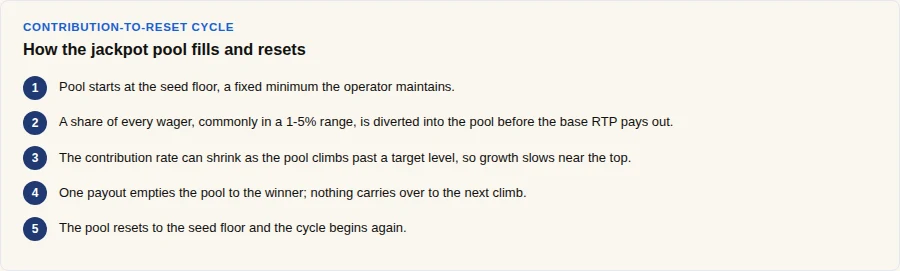
The advertised jackpot figure is a running total of contributions minus whatever has already been paid out, plus the floor it started from. It represents accumulated deductions from every player on the network, growing only as long as players keep wagering. In most structures, the operator underwrites the seed floor, while the total above that comes from wagers.
What resets the pool, and why the seed amount sets the next climb
When the jackpot is won, the pool resets to a fixed floor amount, called the seed, set by the operator or developer. The seed ensures the next jackpot starts from a visible, non-zero figure. This non-zero anchor makes the counter look attractive to the next players.
The seed matters more than it looks. It determines the starting point of the next climb, and therefore how much contribution has to accumulate before the pool reaches the level that drew players in the first place. A high seed means the next jackpot looks attractive sooner. A low seed means a longer, slower build before the counter becomes a headline number.
For a player, the seed is also a reminder of where the money comes from. The floor is typically funded from the same contribution stream, acting as a reserve the operator maintains so the counter never reads zero. The pool a player sees climbing is the seed plus accumulated contributions since the last win, minus the payout that reset it.
That reset is the single event that defines the whole cycle. Every wager between one win and the next feeds a pool that will, at some point, be emptied by a single player and reset to the floor. The mechanics are simple once the flow is clear. Contributions go in, one payout comes out, the pool resets to seed, and the cycle repeats.
The moment someone wins: the verification tiers that unlock a payout this size
A large jackpot win passes through a tiered identity and source-of-funds process. Each tier unlocks a higher payout ceiling, and this gate structure is standard across the industry and most often surprises winners.
The three tiers follow a sequence.
- Basic identity check. A government ID plus a selfie or liveness check unlocks small cash-outs. This is the entry tier, and most players clear it at sign-up or on their first withdrawal.
- Proof of address. A document confirming where the player lives unlocks higher withdrawal limits. Without it, the account is capped at the lower tier regardless of the balance.
- Source-of-funds documentation. Payslips, bank statements, or similar evidence of where the money came from are required to unlock the largest payouts. This is the tier that a life-changing jackpot will almost always trigger.
The logic behind the tiers is that larger payouts require deeper scrutiny of the money behind them. A small withdrawal needs a confirmed identity. A large one requires a confirmed explanation of the funds in the account. This breakdown of why casinos delay withdrawals for verification covers how these queues stack up in practice.
The order matters. A winner cannot skip to the top tier because the win is large. Each tier has to be cleared in sequence, and the source-of-funds stage is the one that most often adds time, because it depends on documents the player has to produce and a reviewer has to assess.
Why an already-verified account still gets re-reviewed on a big win
A verified account may still trigger a fresh review on a large win. When a win is unusually large relative to a player’s normal deposit and play pattern, verification may be re-engaged even when identity was confirmed long ago. The review examines the payout amount and its source within the account history.
A player who has deposited and withdrawn modest amounts for years has a pattern on record. A jackpot that dwarfs that pattern is, from the operator’s side, an anomaly worth a second look. The tiered process re-engages because the payout has moved into a bracket the earlier checks did not cover. This is a common procedure, usually triggered by the payout size.
How long does that take? Manual review of a flagged large withdrawal commonly runs on the order of 24-48 hours beyond the normal processing window. Weekends and holidays stretch it, because the reviewers who clear the file are not working the queue. A win flagged on a Friday evening can sit until the following week before a human picks it up.
The practical point for a winner is to expect the review and prepare for it. Documents requested at the source-of-funds stage are the usual bottleneck, and having them ready shortens the queue.
Lump sum versus structured payout: the exception, not the online norm
Most online slot jackpots pay as a single lump sum once verification clears. The tiered checks above still apply, and the payout still waits on the source-of-funds review. The money arrives all at once in a single payment, which is the ordinary case for online progressive slots.
The lump-sum-versus-annuity choice is a different animal. It applies to very large, life-changing jackpots of the kind associated with wide-area progressive slots. This structure belongs to land-based casinos and lottery-style systems, appearing only rarely online. Winners in this structure face two options.
- A reduced lump sum, roughly 45-60% of the advertised headline figure, paid once.
- The full amount spread over an annuity of 20-30 years, paid in instalments.
A decision window of 60-90 days is typical. In many such structures, if the winner does not choose within that window, the structured option can become the default. This is the clause worth flagging, because a winner who assumes the headline figure is what lands in the account may find the annuity has been selected on their behalf because the window closed.
The gap between the two options is the cost of taking the money early. The reduced lump sum represents the price of immediate access, and the difference is effectively the time value of the deferred payments. For a player on an ordinary online slot, none of this applies. The annuity structure belongs to the wide-area and land-based world, and treating it as the online default is the mistake the fine print is designed to catch.

The fees and delays that sit between the win and the bank account
The headline jackpot figure and the amount that reaches a bank statement differ due to processing steps in between. Each step can carry a cost or a delay not visible in the headline number.
The verification tiers above are the first gate. The source-of-funds review is the second. Beyond those, a payout can pass through an intermediary bank, which may apply its own handling charge or hold the transfer for its own clearing cycle. A withdrawal routed through a correspondent bank differs from a direct payment; the difference shows up as a deduction or a delay the operator’s terms may not spell out in the headline.
This breakdown of hidden fees and fine print is the place to look for how these deductions are buried in the terms. One common pattern to watch for is a fee described in neutral language that, in practice, can reduce the payout by a percentage taken before the number ever reaches the statement. A processing charge, a handling fee, or an intermediary deduction each reduces the amount that actually clears to the player’s bank account.
The delays follow the same logic. A manual review tier adds 24-48 hours beyond the normal window, and a weekend can stretch it further. An intermediary bank adds its own clearing time on top. None of these steps is hidden in the sense of being secret. They are disclosed in the terms, typically in a fee section that winners read only after a jackpot has landed.

The practical preparation is straightforward. A player who expects a large payout can gather the documents the top tier requires before the win, confirm which payment route the operator uses, and read the fee section of the terms before the account gets busy with jackpot logistics. The mechanics of the pool are simple. The mechanics of getting the money out are where the fine print does its work.
FAQ
Does the jackpot pool belong to the operator until someone wins it? No. The pool is built from a small share of every wager, commonly in a rough 1-5% range, diverted before the rest of the bet is paid through the base return-to-player. It is accumulated player contributions held against a future payout, plus the seed floor the operator maintains so the counter never reads zero. The operator administers the pool and sets the seed, but the money in it comes from the wagers placed on the linked machines.
Why does the jackpot sometimes grow more slowly as it gets larger? Some progressive systems use a variable contribution rate. A higher share of each wager is skimmed into the pool while the jackpot is low, and a lower share once it climbs past a target level. Growth is therefore not perfectly linear. A player watching the counter climb cannot assume the same percentage is being added at every stage, because the rate itself changes with the pool size.
If an account is already verified, why does a big win trigger another review? Source-of-funds checks are tied to the amount leaving, not just the identity on file. A win that is unusually large relative to a player’s normal deposit and play pattern can trigger a fresh review even on an already-verified account, because the payout has moved into a bracket the earlier checks did not cover. Manual review of a flagged large withdrawal commonly adds days beyond the normal processing window, longer around weekends and holidays.
Will a large online jackpot be paid as an annuity? Usually not. Most online slot jackpots pay as a single lump sum once verification clears. The lump-sum-versus-annuity choice applies to very large, life-changing jackpots of the kind associated with wide-area progressive slots, where winners are sometimes offered a reduced lump sum or the full amount spread over many years, with a limited decision window. This structure belongs to land-based casinos and lottery games, a rare feature in online slots.
18+. Gambling involves real money and real risk. If betting stops being a cost you can absorb, step back and use the support tools available in your jurisdiction.
Foundation Check
Three things to confirm for yourself, in the platform's own documents, before you act on anything above. This is a checklist, not a score.
- List the documents the platform names as required before a first withdrawal, and confirm you can supply each one.
- Find out whether verification can be completed before you deposit rather than at the moment you want to cash out.
- Check what the platform says happens to a pending withdrawal while documents are being reviewed.